Electrical Outlet Installation in Idaho: What to Check First
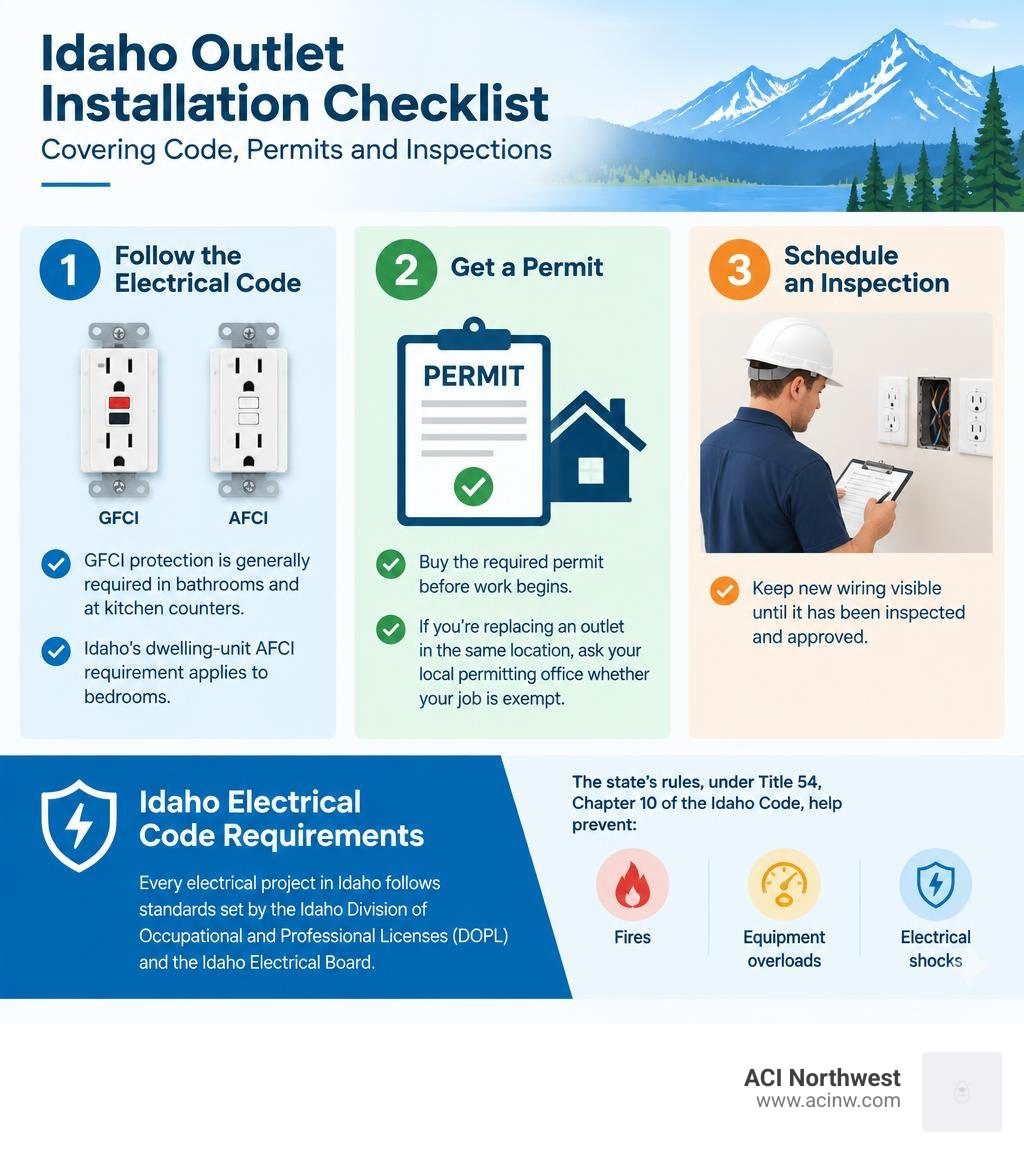
For electrical outlet installation in Idaho, start by checking whether the work needs a permit. A new outlet or circuit must meet Idaho’s adopted electrical code; GFCI protection is generally required in bathrooms and at kitchen counters, while Idaho’s dwelling-unit AFCI requirement applies to bedrooms. Buy any required permit before work begins, and keep new wiring visible until it has been inspected and approved. If you’re replacing an outlet in the same location, ask your local permitting office whether your specific job is exempt.
I’m Bill Radobenko, president and CEO of ACI Northwest in Coeur d’Alene, where I’ve led residential and commercial service teams for over two decades. If you searched for “electrical outlet installation Idaho,” this guide will help you understand the code, permit, and inspection questions to ask before work starts.
Idaho Electrical Code Requirements for Outlet Installation
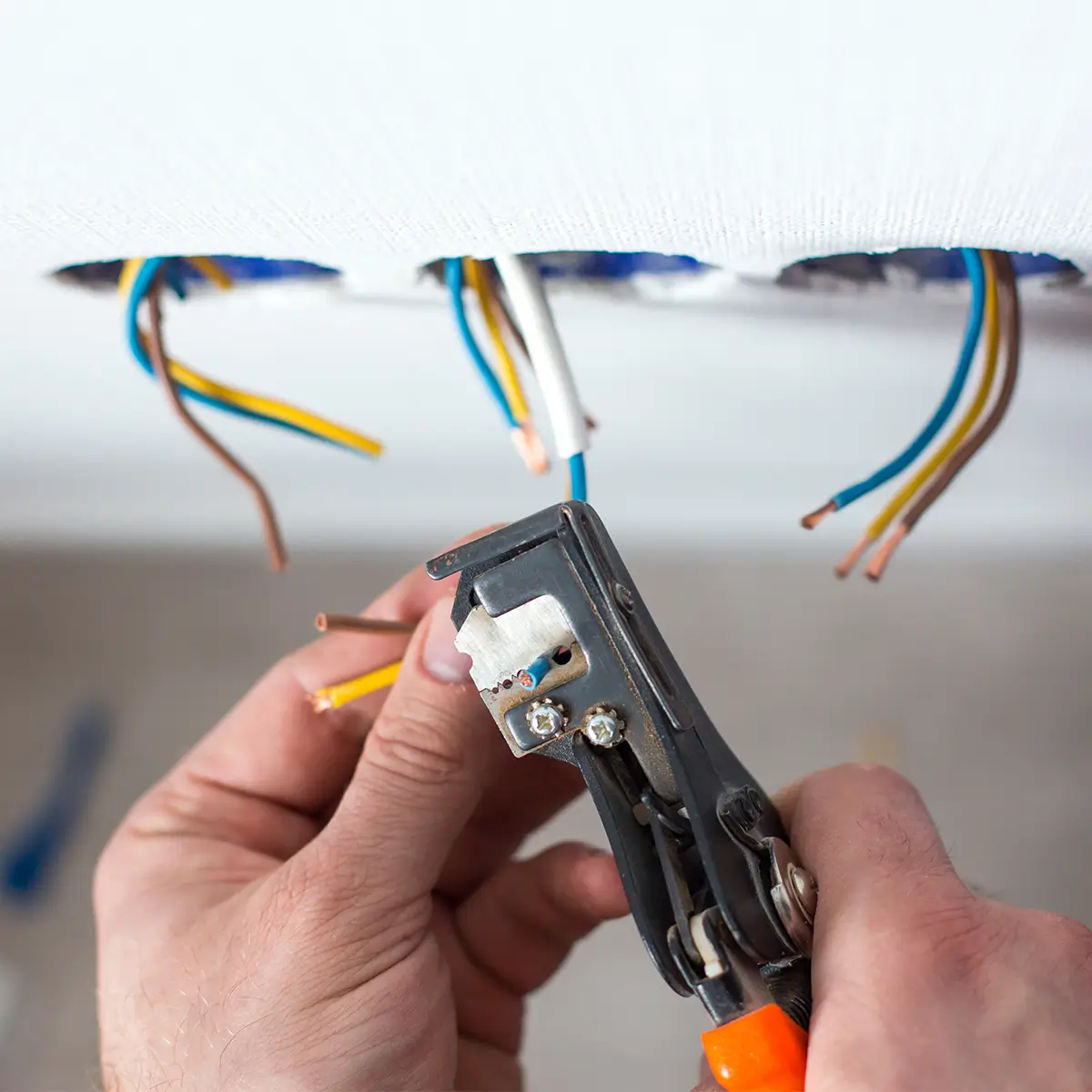
Every electrical project in our state operates under legal standards overseen by the Idaho Division of Occupational and Professional Licenses (DOPL) and the Idaho Electrical Board. Under Title 54, Chapter 10 of the Idaho Code, the state establishes the minimum technical requirements to keep homeowners safe from fires, equipment overloads, and electrical shocks.
Idaho incorporates the 2017 Edition of the National Electrical Code (NEC) by reference, along with targeted state-specific amendments. When planning home updates or adding branch circuits, matching your project to these local codes is essential. Beyond baseline wiring, modern standards mandate tamper-resistant (TR) receptacles in all dwelling units. These outlets feature built-in safety shutters that prevent curious youngsters from inserting foreign objects into live slots—a simple feature that prevents thousands of domestic accidents every year. If you are updating older two-prong receptacles or installing new lines, taking advantage of professional electrical wiring services ensures every connection meets current safety codes.
State NEC Amendments: AFCI and GFCI Standards
While the NEC is adopted across the country, Idaho makes specific amendments to balance practical residential construction needs with homeowner safety. Two of the most crucial safety technologies you will encounter are Ground-Fault Circuit-Interrupters (GFCI) and Arc-Fault Circuit-Interrupters (AFCI).
GFCI devices protect people from severe electrical shocks by cutting power when current leaks along an unintended path, such as through moisture or a person’s body. AFCI devices protect structures by detecting dangerous electrical arcing—sparking that occurs when wires are damaged, pinched, or deteriorated—which is a leading cause of residential electrical fires.
Idaho’s amendments establish distinct boundaries for where these devices are mandatory:
- AFCI Requirements: While newer national codes recommend AFCI protection throughout entire homes, Idaho’s rules specifically focus AFCI protection on dwelling unit branch circuits supplying bedroom outlets.
- GFCI Requirements: Idaho enforces standard interior GFCI safety around high-moisture zones but specifically amended out the national requirements under NEC Article 210.8(F) regarding certain outdoor outlet requirements.
| Receptacle Type | Primary Protection Purpose | Idaho Code Required Locations | Key Installation Feature |
|---|---|---|---|
| Standard TR Outlet | General power supply with child safety | Living rooms, hallways, dining rooms | Internal spring-loaded safety shutters |
| GFCI Outlet | Shock and electrocution prevention | Kitchen counters, bathrooms, basements | Millisecond trip response upon ground leakage |
| AFCI Outlet / Breaker | Fire prevention from wire damage/sparks | Bedroom branch circuits and living spaces | Advanced microprocessor detects erratic arc waves |
Critical Location and Clearance Rules for Residential Receptacles
Code rules govern not just how an outlet functions, but precisely where it must sit on a wall:
- Kitchen Countertops: Receptacles must be placed so that no point along the wall countertop space is more than 24 inches from an outlet. That means you should never have to stretch a kitchen appliance cord more than two feet to find power. Countertop outlets require GFCI protection.
- Bathrooms: At least one GFCI-protected outlet must be installed within 36 inches of the outside edge of each sink basin. These receptacles cannot be installed face-up on countertops.
- Garages and Unfinished Basements: All general-use 125-volt, single-phase 15- and 20-amp receptacles require GFCI protection to protect against damp ground conditions.
- Outdoor Areas: Exterior outlets must be housed in listed weatherproof enclosures with “while-in-use” wet-location covers to prevent water intrusion.
- Laundry Areas: Outlets installed within six feet of the outside edge of a laundry sink must feature accessible GFCI protection.
Permits, Inspections, and Fees for Electrical Outlet Installation in Idaho
Installing new electrical lines or adding new circuits to your home is not a project where you can ask for forgiveness rather than permission. Idaho administrative rules require electrical permits to be purchased before any work commences.
Failing to pull an electrical permit before driving the first staple or stripping the first conductor comes with stiff consequences. The state Electrical Board imposes a double permit fee penalty for jobs started without prior authorization. Furthermore, permits remain valid for 365 days from the date of issue. If the project stalls and no inspections occur within that window, the permit expires, requiring administrative renewal fees to reopen.
Step-by-Step Electrical Permit Process and Fee Schedules
Permits for electrical work in Idaho are categorized by the scope of the project:
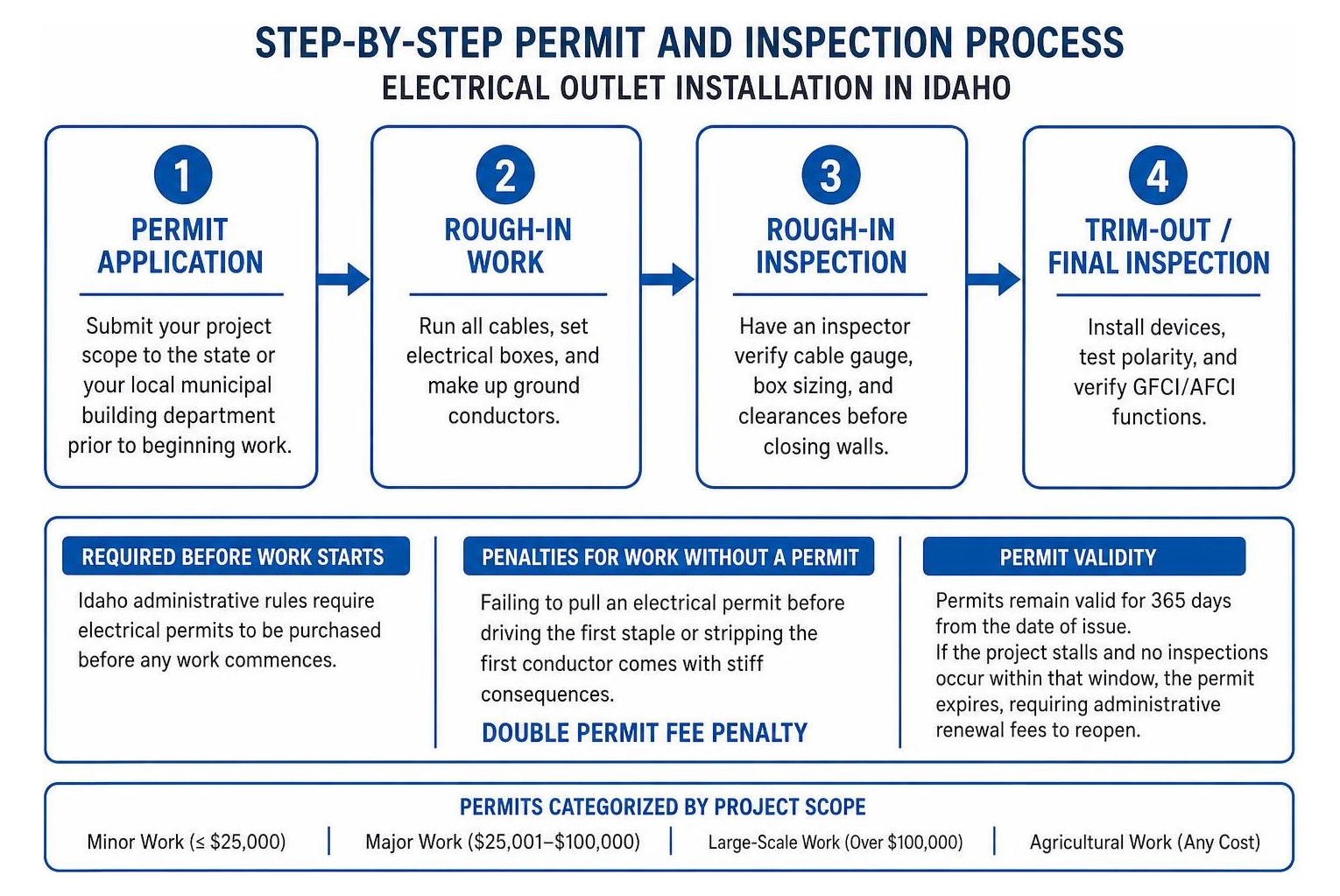
- Permit Application: Submit your project scope to the state or your local municipal building department prior to beginning work.
- Rough-In Work: Run all cables, set electrical boxes, and make up ground conductors.
- Rough-In Inspection: Have an inspector verify cable gauge, box sizing, and clearances before closing walls.
- Trim-Out / Final Inspection: Install devices, test polarity, and verify GFCI/AFCI functions.
Idaho’s permit fee schedule breaks down into distinct tiers:
| Project Category | Scope / Square Footage | State Base Fee | Additional Branch / Sq Ft Fees |
|---|---|---|---|
| New Residential Construction | Up to 1,500 sq ft | $130 | Base flat rate |
| New Residential Construction | 1,501 to 2,500 sq ft | $195 | Base flat rate |
| New Residential Construction | 2,501 to 3,500 sq ft | $260 | Base flat rate |
| New Residential Construction | 3,501 to 4,500 sq ft | $325 | Base flat rate |
| New Residential Construction | Over 4,500 sq ft | $325 | +$65 per additional 1,000 sq ft |
| Existing Residential Work | Remodels & Circuit Additions | $65 | +$10 per additional branch circuit |
| Minor Adjustments | Work under $500 (no service change) | $10 | Base flat rate |
| Virtual Inspection Request | Qualified minor reinspections | $45 | Per virtual inspection session |
Mandatory Electrical Inspections and Concealment Rules
One of the strictest rules enforced by Idaho electrical inspectors is the prohibition of concealment. Under state law, no wiring, junction box, or conduit run may be covered by drywall, insulation, siding, or paneling until it has been inspected and signed off.
If an eager homeowner or uncertified installer covers up cabling before the rough-in inspection, inspectors have the authority to issue a stop-work notice and require the removal of newly installed drywall at the owner’s expense. During both rough-in and final inspections, inspectors verify line-side versus load-side wiring on safety devices, box capacity calculations, grounding paths, and wire gauge compatibility with the connected circuit breaker.
Who Can Legally Perform Electrical Outlet Installation in Idaho?
Electrical work carries significant fire and life-safety risks, which is why Idaho law strictly defines who can install or modify branch wiring. Under Title 54, Chapter 10 of the Idaho Code, anyone offering electrical installation services to the public must hold a valid electrical contractor license and employ a designated master electrician or supervising journeyman. Understanding the importance of professional electrical wiring helps keep your home safe from common installation mistakes.
Hiring a certified professional gives you peace of mind that your home’s circuitry is safe, balanced, and fully compliant with local codes. Exploring the full range of 6 wiring services a professional electrician can help with demonstrates why certified expertise makes a dramatic difference in complex modern electrical systems.
Contractor Licensing and Journeyman Qualifications
To become a licensed journeyman electrician in Idaho, a tradesperson must complete extensive training:
- A minimum of 8,000 hours (four full years) of practical, hands-on work experience under the direct supervision of a licensed journeyman, coupled with four years of accredited classroom instruction.
- Alternatively, candidates may qualify by proving 16,000 hours (eight years) of verified on-the-job electrical work experience.
- Journeyman and master electricians must complete 24 hours of continuing education every three years, including a minimum of 8 hours of direct code updates covering changes in the National Electrical Code.
Contractor companies must maintain active worker’s compensation insurance, liability coverage, and state contractor licensing, ensuring homeowners are never held liable for accidental property damage or job-site injuries.
DIY Rules vs. Penalties for Unlicensed Electrical Work
Idaho allows homeowners to perform electrical work on their own primary, owner-occupied single-family residence. However, this exception does not remove the legal requirement to pull permits and pass official inspections. If you own a rental property, a commercial building, or a home you plan to flip without occupying, you cannot perform DIY electrical wiring under state law.
Furthermore, state statutes carry strict penalties for unlicensed individuals who advertise, bid, or perform electrical contracting work. In addition to potential misdemeanor citations and stop-work orders, unpermitted or improperly completed DIY electrical installations can jeopardize your homeowner’s insurance policy. If faulty wiring causes a fire, insurers may investigate whether the work was permitted and inspected by local authorities before approving coverage. When safety issues surface, it pays to make a resolution to get these home wiring problems fixed by a qualified pro before small errors turn into costly hazards.
Upstream Power and Utility Guidelines for New Outlet Circuits
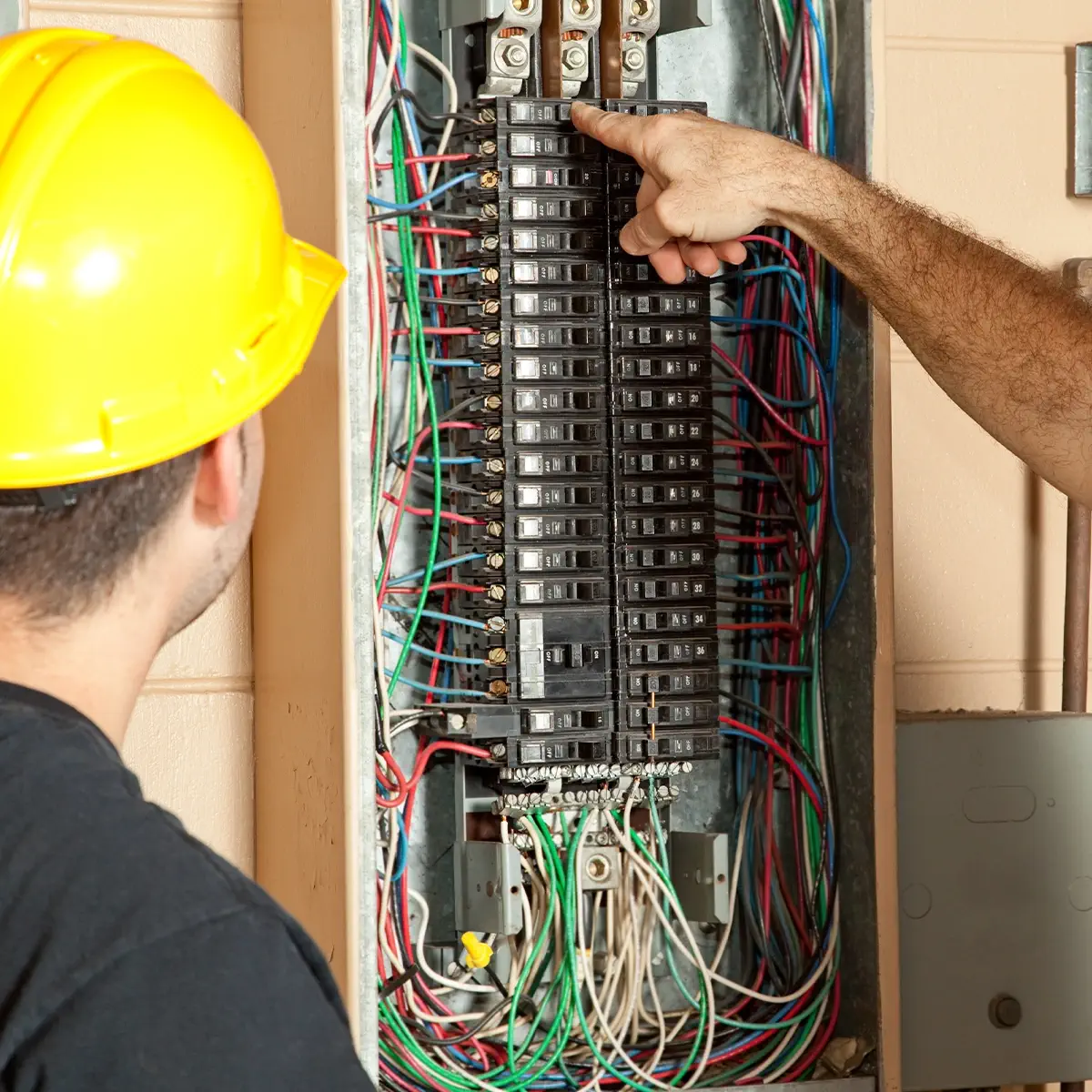
Every new outlet you plug a vacuum, computer, or power tool into relies entirely on the upstream infrastructure that feeds your home. If your main service panel or incoming power lines cannot support the extra load, adding branch circuits will lead to nuisance breaker trips or system overloads.
When expanding living spaces, building an accessory dwelling unit (ADU), or upgrading your service drop, regional utilities like Idaho Power have strict installation standards that work side-by-side with municipal electrical codes.
Planning Service Capacity and Idaho Power Utility Standards
For underground residential electrical service installations, Idaho Power sets precise physical and technical requirements:
- Conduit Sizing: Standard 200-amp residential services require 2-inch Schedule 40 or Schedule 80 PVC conduit. Larger 400-amp services require 3-inch PVC conduit.
- Trench Burial Depth: Underground conduit must have a minimum cover of 30 inches at final grade, but must not be buried deeper than 36 inches. The initial 6 inches of backfill must be clean native soil free of sharp rocks larger than 2 inches.
- Conduit Routing and Bends: The total horizontal distance between Idaho Power’s source equipment and your meter base cannot exceed 125 feet. All subterranean 90-degree elbows must be manufactured bends with a minimum radius of 24 inches—field-heating conduit with a torch to make custom bends is strictly prohibited. Total bends along the underground run cannot exceed 135 degrees.
- Meter Socket Clearance: The center of the electric meter base must be mounted between 4 and 6 feet above finished grade (5 feet 6 inches preferred), with a 36-inch by 36-inch clear working space directly in front of the enclosure.
- Available Fault Current (AIC): Equipment must withstand potential fault currents. Single-family homes close to a transformer may require equipment rated for 22,000 AIC (Amperes Interrupting Capacity), while homes positioned further away typically utilize standard 10,000 AIC ratings.
When Electrical Outlet Installation in Idaho Requires a Panel Upgrade
Modern homes use significantly more electricity than homes built several decades ago. If you are adding dedicated 20-amp appliance circuits, an EV charging outlet, or a subpanel for a shop, you may find your existing panelboard lacks physical breaker space or total electrical capacity.
Recognizing the key signs your electrical panel needs an upgrade—such as flickering lights, warm breaker surfaces, or obsolete fuse boxes—is the first step toward a safe expansion. When power demands surpass your service limits, scheduling comprehensive electrical panel services will ensure your home safely accommodates new high-draw circuits. This is especially true for major outdoor additions; learning why you need an electrician for a hot tub installation will show you how heavy heating elements and pump motors require dedicated service planning, GFCI disconnects, and proper utility sizing.
Frequently Asked Questions About Idaho Electrical Outlets
Do I need a permit to replace an existing outlet in Idaho?
Replacing a single standard outlet with an identical replacement in the exact same location is often treated as minor maintenance. However, if you are running new Romex cable back to your breaker box, adding a brand-new branch circuit, altering box enclosures inside the wall, or changing circuit amperage, you must obtain a permit through the state or your municipal building department before starting. When in doubt, checking with your local building official ensures you stay on the right side of the law.
Where are GFCI outlets legally required in an Idaho home?
Under Idaho’s electrical codes, GFCI protection is mandatory for receptacles installed in:
- Bathrooms (within 3 feet of basins)
- Kitchen countertop areas serving small appliances
- Unfinished basements and crawl spaces
- Garages and accessory work buildings
- Laundry rooms within 6 feet of sinks
- Dedicated wet-bar or utility sink locations
Always use tested, UL-listed GFCI receptacles or dual-function AFCI/GFCI circuit breakers to protect these critical zones.
What are the penalties for doing unpermitted electrical work in Idaho?
Performing unpermitted electrical work in Idaho exposes property owners to double permit fees when discovered by building officials. Inspectors can issue immediate stop-work orders and mandate that walls be opened up so hidden wiring can be reviewed. Additionally, unpermitted electrical work can complicate real estate transactions during buyer home inspections and may lead insurance companies to deny claims if uncertified wiring causes a house fire.
Conclusion
Safe, dependable electrical power is something we all rely on every day, but adding or modifying branch circuits requires careful attention to detail. From matching the right GFCI and AFCI devices to bedroom and kitchen spaces, to pulling the proper permits and passing rough-in inspections before closing your walls, following Idaho’s electrical regulations protects your property and your family.
Investing in long-term safety is easy with an ongoing electrical maintenance plan, which keeps your panel, breakers, and receptacles operating at peak reliability year after year.
When you need top-tier electrical craftsmanship backed by decades of local experience, our team at ACI Northwest is here to help. Serving Coeur d’Alene and surrounding North Idaho communities since 1992, our licensed electricians handle everything from simple receptacle updates to complete residential panel replacements with fast, reliable, code-compliant service. Contact us today to schedule your next electrical project!